Documentation of the SHiP-framework!
Similarity-Hierarchical-Partitioning (SHiP) Clustering Framework


This repository is the official implementation of the Similarity-Hierarchical-Partitioning (SHiP) clustering framework proposed in Ultrametric Cluster Hierarchies: I Want `em All! This framework provides a comprehensive approach to clustering by leveraging similarity trees, \((k,z)\)-hierarchies, and various partitioning objective functions.
The whole project is implemented in C++ and Python bindings enable the usage within Python.
Overview
The SHiP framework operates in three main stages:
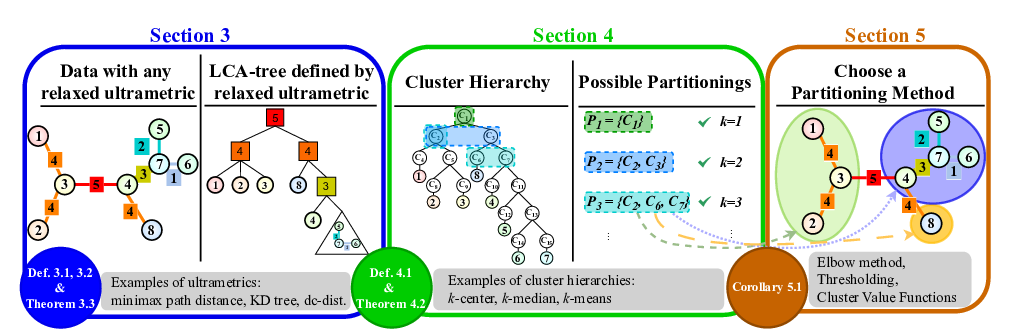
Similarity Tree Construction: A similarity tree is built for the given dataset. This tree represents the relationships and proximities between data points. Note that the default constructed tree corresponds to the \(k\)-center hierarchy (Section 3 in the paper).
\((k,z)\)-Hierarchy Construction: Using the similarity tree, a \((k,z)\)-hierarchy can be constructed. These hierarchies correlate to common center based clustering methods, as e.g., \(k\)-median or \(k\)-means (Section 4).
Partitioning: Finally, the data is partitioned based on the constructed hierarchy and a user-selected partitioning objective function (Section 5).
Features
Similarity Trees: The package provides a set of similarity/ultrametric tree implementations:
\((k,z)\)-Hierarchies: It supports all possible \((k,z)\)-hierarchies, allowing flexibility in choosing the most suitable hierarchy for a given dataset.
\(z = 0\) → \(k\)-center (actually in theory: \(z = ∞\), but in this implementation we use 0 for \(∞\))
\(z = 1\) → \(k\)-median
\(z = 2\) → \(k\)-means
…
Partitioning Functions: A wide range of partitioning functions are available, enabling users to select the most appropriate function based on their specific needs:
KElbowThresholdThresholdElbowQCoverageQCoverageElbowQStemQStemElbowLcaNoiseElbowLcaNoiseElbowNoTriangleMedianOfElbowsMeanOfElbowsStabilityNormalizedStability
Customization: Users can customize the framework by selecting from the available similarity trees, \((k,z)\)- hierarchies, and partitioning functions.
E.g.,
DCTreewith \(k\)-means (\(z=2\))-hierarchy and theElbowpartitioning method.from SHiP import SHiP # Build the `DCTree` ship = SHiP(data=data_points, treeType="DCTree") # Extract the clustering from the $k$-median hierarchy and the `Elbow` partitioning method labels = ship.fit_predict(hierarchy=2, partitioningMethod="Elbow")
Installation
Stable Version
The current stable version can be installed by the following command:
pip install SHiP-framework (coming soon)
Note that a gcc compiler is required for installation. Therefore, in case of an installation error, make sure that:
Windows: Microsoft C++ Build Tools is installed
Linux/Mac: Python dev is installed (e.g., by running
apt-get install python-dev- the exact command may differ depending on the linux distribution)
The error messages may look like this:
error: command 'gcc' failed: No such file or directory
Could not build wheels for SHiP-framework, which is required to install pyproject.toml-based projects
Microsoft Visual C++ 14.0 or greater is required. Get it with "Microsoft C++ Build Tools
Development Version
The current development version can be installed directly from git by executing:
sudo pip install git+https://github.com/pasiweber/SHiP-framework.git
Alternatively, clone the repository, go to the root directory and execute:
pip install .
Code Example
from SHiP import SHiP

ship = SHiP(data=data, treeType="DCTree")

# or to load a saved tree
ship = SHiP(data=data, treeType="LoadTree", config={"json_tree_filepath": "<file_path>"})
# or additionally specify the tree_type of the loaded tree by adding {"tree_type": "DCTree"}

ship.hierarchy = 0
ship.partitioningMethod = "K"
labels = ship.fit_predict()

# or in one line
labels = ship.fit_predict(hierarchy = 1, partitioningMethod = "Elbow")

# optional: save the current computed tree
json = ship.get_tree().to_json()
Results
Our framework achieves the following performance:
Dataset |
DC-0-Stab. |
DC-1-MoE |
DC-2-Elb. |
CT-0-Stab. |
CT-1-MoE |
CT-2-Elb. |
\(k\)-means |
SCAR |
Ward |
AMD-DBSCAN |
DPC |
|---|---|---|---|---|---|---|---|---|---|---|---|
Boxes |
90.1 |
99.3 |
97.9 |
2.6 |
42.1 ± 4.7 |
24.2 ± 1.6 |
93.5 ± 4.3 |
0.1 ± 0.1 |
95.8 |
63.9 |
25.9 |
D31 |
79.7 |
42.7 |
82.9 |
46.5 ± 1.8 |
62.0 ± 5.4 |
67.7 ± 3.2 |
92.0 ± 2.7 |
41.7 ± 5.4 |
92.0 |
86.4 |
18.5 |
airway |
38.0 |
65.9 |
58.8 |
0.8 |
18.2 ± 2.4 |
12.0 ± 1.4 |
39.9 ± 2.0 |
-0.9 ± 0.5 |
43.7 |
31.7 |
65.1 |
lactate |
41.0 |
41.0 |
67.5 |
0.1 |
4.1 ± 0.6 |
1.7 ± 0.2 |
28.6 ± 1.1 |
1.5 ± 1.0 |
27.7 |
71.5 |
0.0 |
HAR |
30.0 |
46.9 |
52.8 |
14.7 ± 8.8 |
14.2 ± 4.7 |
9.6 ± 2.2 |
46.0 ± 4.5 |
5.5 ± 3.2 |
49.1 |
0.0 |
33.2 |
letterrec. |
12.1 |
16.6 |
17.9 |
5.8 ± 0.2 |
7.2 ± 0.6 |
6.2 ± 0.3 |
12.9 ± 0.6 |
0.4 ± 0.1 |
14.7 ± 0.9 |
7.9 |
0.0 |
PenDigits |
66.4 |
73.1 |
75.4 |
8.0 ± 0.8 |
12.0 ± 0.6 |
8.9 ± 0.5 |
55.3 ± 3.2 |
0.9 ± 0.3 |
55.2 |
55.6 |
28.8 ± 1.1 |
COIL20 |
81.2 |
72.8 |
72.6 |
46.4 ± 4.4 |
46.6 ± 2.1 |
47.7 ± 2.0 |
58.2 ± 2.8 |
33.5 ± 2.0 |
68.6 |
39.2 |
35.9 ± 0.1 |
COIL100 |
80.1 |
66.8 |
70.0 |
44.6 ± 4.2 |
46.6 ± 1.5 |
50.1 ± 1.2 |
56.1 ± 1.4 |
16.7 ± 0.8 |
61.4 |
14.2 |
0.2 |
cmu_faces |
60.2 |
56.6 |
66.5 |
8.6 ± 3.1 |
37.1 ± 4.1 |
34.2 ± 2.1 |
53.2 ± 4.7 |
38.5 ± 2.9 |
61.6 |
0.7 |
0.6 |
OptDigits |
55.3 |
77.0 |
77.0 |
40.9 ± 3.5 |
20.9 ± 2.3 |
18.1 ± 2.4 |
61.3 ± 6.6 |
14.4 ± 4.1 |
74.6 ± 2.4 |
63.2 |
0.0 |
USPS |
33.7 |
29.3 |
29.3 |
12.0 ± 1.7 |
8.7 ± 1.0 |
11.2 ± 1.5 |
52.3 ± 1.7 |
2.9 ± 0.9 |
63.9 |
0.0 |
21.0 |
MNIST |
19.7 |
41.7 |
46.0 |
11.1 ± 1.7 |
5.4 ± 0.6 |
5.4 ± 0.6 |
36.9 ± 1.0 |
1.3 ± 0.4 |
52.7 |
0.0 |
- |
DC = DCTree,CT = CoverTreeStab. = Stability,MoE = MedianOfElbows,Elb. = ElbowCompetitors: k-means, SCAR, Ward, AMD-DBSCAN, DPC
License
The project is licensed under the BSD 3-Clause License (see LICENSE.txt).
References
[1] Connecting the Dots – Density-Connectivity Distance unifies DBSCAN, k-Center and Spectral Clustering
[2] HST+: An Efficient Index for Embedding Arbitrary Metric Spaces
(Github)
[3] mlpack 4: a fast, header-only C++ machine learning library
(Github)